Your air fryer shuts off mid-cook and half the kitchen goes dark. You reset the breaker, and twenty minutes later it happens again.
There are really only two situations here, and from the outside they look identical. Either the circuit is carrying more than it can handle, or something inside the appliance has failed. The first is an inconvenience you can fix in ten minutes. The second is a fire risk you should not keep resetting your way through.
This guide separates them, starting with a test that takes about a minute.
Electrical figures on this page assume 120 V, 60 Hz North American residential wiring on a 15 A or 20 A branch circuit.
Start here: the 60-second isolation test
Do this before reading anything else. It eliminates more possibilities than any amount of reading will.
- Unplug everything else on that stretch of counter. Kettle, toaster, coffee maker, microwave, phone chargers — everything.
- Plug the air fryer directly into the wall. No power strip, no extension cord, no surge protector.
- Run it empty at a normal temperature for two minutes. You are not cooking. You just want to see whether it trips.
If it doesn’t trip: you have an overload. Skip to It’s an overload below.
If it still trips with nothing else running: treat it as a fault until proven otherwise. Skip to It’s the appliance.
That one result cuts the problem roughly in half.
First, work out what actually tripped
People say “the breaker tripped” for three different events with three different causes. Getting this wrong sends you down the wrong path entirely, and almost every other guide on this topic treats them as the same thing.
| What you saw | What it is | What it means |
|---|---|---|
| A switch in the panel moved to the middle or off | Standard breaker trip | Overload or short circuit |
| A button popped out on the outlet itself | GFCI trip | Current leaking to ground — often moisture |
| Panel switch tripped, and that breaker has its own small test button | AFCI or dual-function trip | Detected arcing — sometimes real, sometimes a false alarm |
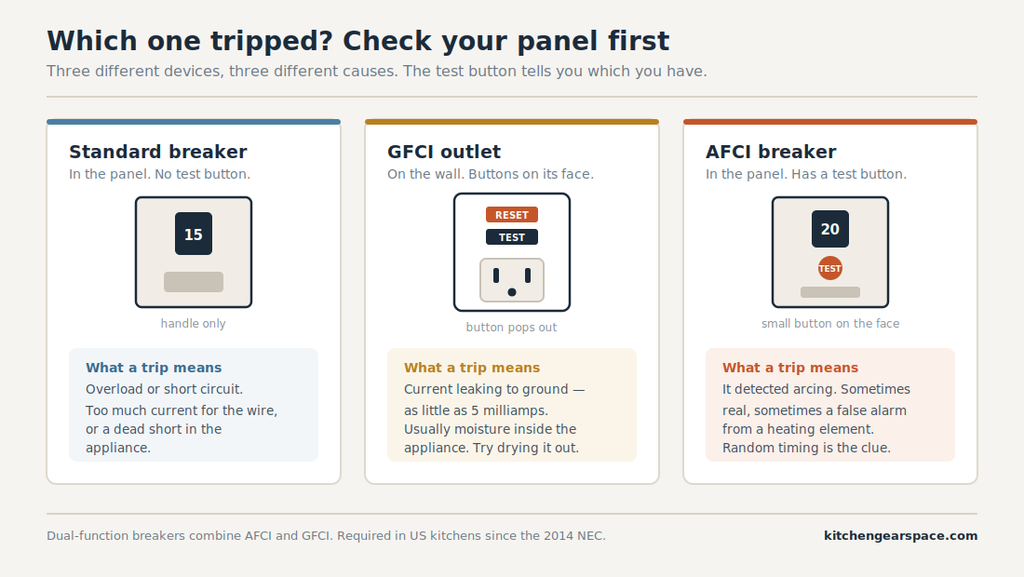
Go and look at your panel. Breakers with a small coloured test button on the face are AFCI, GFCI or dual-function devices. Plain breakers with nothing but a handle are standard thermal-magnetic breakers.
A GFCI trip and an overload trip have almost nothing in common. Identify yours before going further.
The math nobody shows you
Here is why this problem became so common in the last few years.
A 15 A circuit at 120 V has a theoretical ceiling of 1,800 watts. The practical planning limit is 80% of that — 1,440 watts — which is the figure electricians design to and what the National Electrical Code requires for sustained loads.
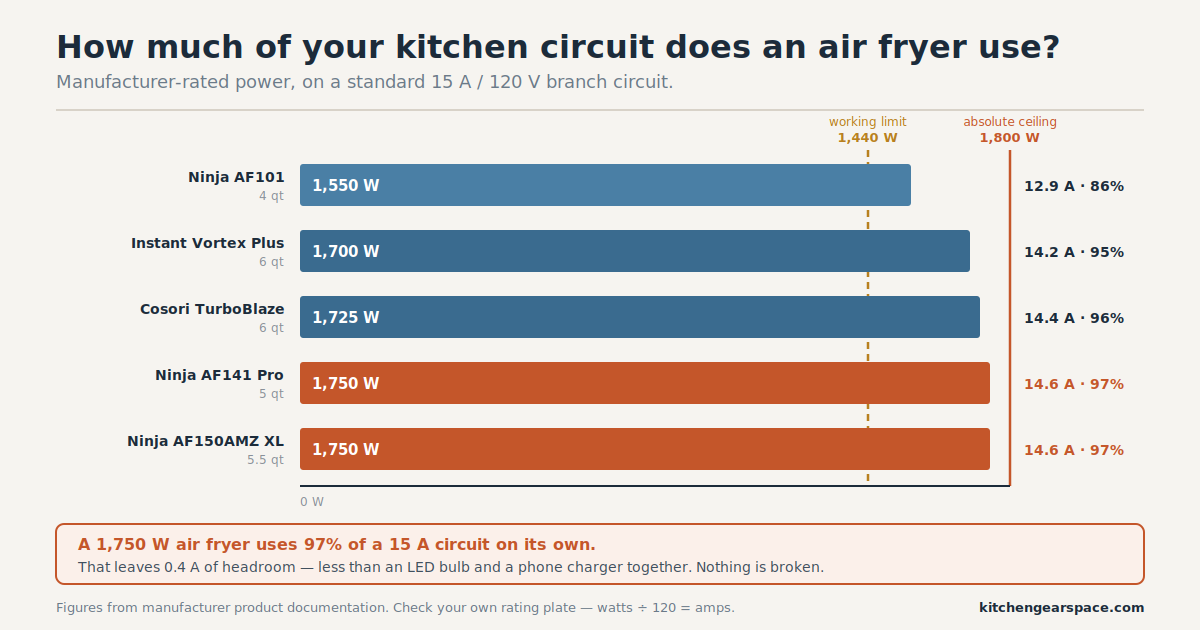
Now look at what a current air fryer actually draws. These figures come from manufacturer specifications:
| Model | Rated power | Amps at 120 V | Share of a 15 A circuit |
|---|---|---|---|
| Ninja AF101 (4 qt) | 1,550 W | 12.9 A | 86% |
| Instant Vortex Plus (6 qt) | 1,700 W | 14.2 A | 95% |
| Cosori TurboBlaze (6 qt) | 1,725 W | 14.4 A | 96% |
| Ninja AF141 Pro (5 qt) | 1,750 W | 14.6 A | 97% |
| Ninja AF150AMZ XL (5.5 qt) | 1,750 W | 14.6 A | 97% |
A 1,750-watt air fryer on a 15 A circuit is using 97% of that circuit by itself. There is 0.4 A of headroom left — less than an LED bulb and a phone charger combined.
This is the answer for most people asking this question. Nothing is broken. The appliance is simply larger than the circuit was designed around. Air fryers grew from around 1,200 W a decade ago to 1,700–1,800 W today. Kitchen wiring did not grow with them.
On a 20 A circuit the numbers are comfortable: a 2,400 W ceiling and a 1,920 W planning limit. That same 1,750 W air fryer sits at 73%, and should not trip anything on its own.
To find your circuit rating: open the panel and read the number stamped on the end of the breaker handle. It will say 15 or 20.
To find your air fryer’s wattage: check the rating plate on the underside or rear panel — not the marketing copy. Divide the watts by 120 to get amps. Anything above 12 A wants a circuit to itself.
What the timing tells you
Circuit breakers have two separate trip mechanisms, and which one fired tells you what went wrong.
The thermal element is a bimetallic strip that bends as it heats. It reacts slowly — an overload has to persist. The magnetic element responds to a sudden enormous surge and acts in milliseconds.
So the timing is diagnostic:
| When it trips | Mechanism | Most likely cause |
|---|---|---|
| The instant you plug it in | Magnetic | Dead short in the appliance or cord — stop using it |
| 1–3 seconds after switching on | Magnetic | Heating element shorted to chassis |
| 5–20 minutes into cooking | Thermal | Genuine overload — the circuit is over capacity |
| Randomly, no pattern | Neither | Loose connection, or an AFCI false positive |
| Only when something else kicks in | Thermal | Shared circuit, combined load too high |
If your air fryer trips the breaker the moment it is plugged in, stop troubleshooting. Unplug it and don’t use it.
It’s an overload
Your isolation test passed, so the appliance is fine. It just needs more circuit.
Move it to a different circuit. The easiest fix, and the one most people skip. Outlets on opposite walls are often on different circuits — but not always, and “different outlet” does not mean “different circuit.” To find out, switch off one breaker at a time and see which outlets go dead. Label the panel while you’re there.
Stop sharing. Kitchen small-appliance circuits are permitted to serve the dining room and pantry too, so a slow cooker in the next room may be on the same wire. Anything with a heating element — kettle, toaster, coffee maker, warming tray — is the real competition. A blender barely registers by comparison.
Take it off the power strip. Not because of the strip’s amp rating, but because of heat: every extra connection adds contact resistance, and resistance carrying 14 A continuously gets warm. Strip contacts are not built for sustained high-current heating loads. Plug it straight into the wall. If you’ve daisy-chained one strip into another, fix that today regardless of the air fryer.
Consider a dedicated circuit. If you use the air fryer daily and your kitchen is on 15 A circuits, an electrician can run a dedicated 20 A line. It typically costs a few hundred dollars and permanently ends the problem. For a 1,700 W-plus appliance in an older home, this is usually the right answer rather than a workaround.
Or buy a smaller unit. A 1,550 W model draws 1.7 A less than a 1,750 W one. On a marginal circuit that difference is often decisive, and the cooking performance gap is smaller than the wattage suggests. Our guide to energy-efficient air fryers covers which models draw least.
It’s the appliance
Your air fryer tripped the breaker with nothing else running. Before condemning it, rule out the outlet.
Test it on a different circuit — ideally another room, on a circuit you know is lightly loaded. If it trips there too, the appliance is at fault. If it runs fine, the problem was the original circuit.
Inspect the cord and plug. Look for cracked insulation, exposed conductor near the strain relief, bent or discoloured prongs, or a plug that sits loose in the outlet. Feel the plug after a few minutes of running: warm is normal, hot is not.
Look at the heating element. Unplugged and cool, look into the top of the cooking chamber. You’re looking for a visible break in the coil, heavy carbon buildup, or a section that looks blistered or discoloured differently from the rest. An element that has shorted to the chassis will trip a breaker every time.
Check for an error code instead of a trip. If the display shows a code rather than cutting power to the room, that’s a different fault entirely — see our guide to the E1 error.
If the appliance trips a breaker on a known-good circuit, stop using it. Check whether it’s still under warranty and contact the manufacturer. Do not open it. The heating element and control board carry mains voltage, and there is nothing user-serviceable inside a sealed air fryer.
If it’s a GFCI trip: check for moisture first
A GFCI compares the current going out on the hot conductor with the current returning on the neutral. If more than about 5 milliamps goes missing — meaning it found another path to ground — it cuts power. That is five thousandths of an amp. It is an extraordinarily sensitive measurement, designed to protect you rather than the appliance.
The most common cause of an air fryer tripping a GFCI is moisture inside the appliance, usually a few days after someone washed it too enthusiastically. Damp insulation conducts just enough current to ground to cross the threshold.
The fix: unplug and let it dry somewhere warm for 24 to 48 hours. Not in an oven, not with a heat gun. Then try again. A surprising number of “broken” air fryers recover completely.
If it still trips a GFCI after drying, insulation has degraded and current is genuinely leaking to the chassis. That is a shock hazard — retire the appliance.
Also worth checking: a damp outlet near a sink, or a GFCI device that is simply worn out. They do fail with age. Press TEST and RESET; if the buttons feel dead, or reset won’t hold with nothing plugged in, the device needs replacing.
If it’s an AFCI trip: this may not be your fault
AFCI protection has been required in kitchens since the 2014 National Electrical Code, so newer and recently rewired homes have it.
An AFCI listens for the electrical signature of an arc — the high-frequency noise a dangerous arcing connection produces. When it finds one, it is doing genuinely important work: arc faults start fires that standard breakers never catch.
The complication is that some appliances produce noise resembling an arc signature. Devices with brushed motors, switching power supplies and rapidly cycling heating elements are the usual suspects, and an air fryer contains at least two of those. The result is a nuisance trip — the device doing exactly what it was designed to do, on a signal that wasn’t actually a fault.
How to tell: nuisance AFCI trips are random. They don’t correlate with how many other appliances are running or how long you’ve been cooking. The isolation test passes one day and fails the next. An overload, by contrast, is repeatable.
What to do: report the pattern to an electrician, including which appliance triggers it and how random the timing is. Options include relocating the appliance to a non-AFCI circuit where code permits, or fitting a newer combination AFCI — later generations discriminate real arcs far better than early ones did.
What not to do: don’t remove the AFCI protection.
The one thing you must never do
Never replace a 15 A breaker with a 20 A breaker to stop the tripping.
This gets suggested constantly in comment sections, and it is the most dangerous advice in this entire subject.
A breaker does not protect the appliance. It protects the wire inside your walls. A 15 A circuit is wired with 14 AWG conductor, rated to carry 15 amps and no more. Fit a 20 A breaker and that wire will be asked to carry 20 amps — heating up inside a wall cavity, with no breaker willing to interrupt it, until something ignites.
Upsizing a breaker requires upsizing the conductor to 12 AWG, which means rewiring the circuit. That is electrician work and it is the whole job, not a five-dollar part swap.
While we’re here: a breaker that trips is a breaker that is working. The common belief that old breakers “get weak and trip too easily” is mostly backwards. Breakers do fail with age, but the more common failure mode is failing to trip when they should — which is far more dangerous, and completely invisible until it matters.
About inrush current
You will read that air fryers trip breakers because of a large surge at startup. This is worth examining, because it’s mostly not true.
There is a brief surge. The fan motor draws locked-rotor current for a fraction of a second, and the heating element’s resistance rises slightly as it heats. But air fryer elements are typically nickel-chromium alloy, chosen specifically because resistance barely changes with temperature — so element inrush is small, and the fan motor is a low-wattage component.
Meanwhile, the magnetic trip element in a 15 A breaker generally needs somewhere around five to ten times its rating before acting instantaneously. An air fryer does not come close.
The practical takeaway: if your breaker trips reliably at the moment of switch-on, the cause is far more likely a short circuit inside the appliance than normal startup inrush. Treat it as a fault, not a quirk.
When to stop and call an electrician
These are wiring symptoms, not appliance symptoms. None of them are things to work around.
- Scorch marks, melted plastic or discolouration on an outlet or plug face
- A burning smell coming from the wall or outlet rather than the appliance — if the smell is from the appliance itself, see why air fryers smell like burning
- An outlet hot to the touch, or a plug that won’t stay seated
- The breaker itself feeling hot, or the panel humming, buzzing or crackling
- Lights across the house dimming when the air fryer starts
- The main breaker tripping rather than a branch circuit breaker
- The same breaker tripping with several different appliances
That last one is the clearest sign the problem was never the air fryer.
The U.S. Consumer Product Safety Commission publishes home electrical safety guidance worth reading if any of the above applies to your kitchen.
Preventing it
Give it a circuit it can actually live on. Above 1,500 W on a 15 A circuit, plan on it being the only thing running.
Plug into the wall, always. No strips, no extension cords, no exceptions for high-wattage appliances.
Keep it clear of the wall and cabinets. Recirculated hot exhaust makes everything inside run hotter — see our guide to air fryer clearance requirements.
Check the wattage before you buy the next one. It’s on the rating plate and in the manual. Manufacturers publish it — Instant Pot lists 1,700 W at 120 V for the Vortex Plus, for example — but you’ll rarely see it in the marketing.
Frequently asked questions
Why does my air fryer trip the breaker when my microwave doesn’t? Most microwaves draw 1,000–1,200 W. Most current air fryers draw 1,550–1,750 W. On a 15 A circuit that’s the difference between two-thirds of the circuit and nearly all of it.
How many amps does an air fryer use? Divide the wattage on the rating plate by 120. A 1,550 W model draws 12.9 A; a 1,750 W model draws 14.6 A.
Can I use a surge protector or power strip with my air fryer? Better not to. It’s less about the strip’s amp rating than about heat — every extra connection adds contact resistance, and resistance carrying 14 A continuously gets warm. Plug it into the wall.
Is it safe to just reset the breaker and carry on? Once, if you know what caused it. Repeatedly, no. A breaker that keeps tripping is reporting something, and resetting it without finding out what is how electrical fires start.
Do I need a dedicated circuit for an air fryer? Not always. But if the appliance is above roughly 1,500 W and your kitchen is on 15 A circuits, it’s the fix that actually works. On a 20 A circuit a single air fryer is generally fine.
Will a voltage stabiliser or AVR help? No. Those address voltage fluctuation. Your problem is current draw, and a stabiliser doesn’t reduce the current the appliance needs.
My air fryer trips the breaker in every outlet I try. What now? That points at the appliance rather than the wiring. Stop using it, check the warranty, and contact the manufacturer. Don’t open it.
About this article
This guide was written from an electrical engineering perspective, using manufacturer specifications, appliance rating-plate figures, National Electrical Code requirements, and analysis of recurring failure reports. Wattage figures are taken from manufacturer product documentation. Electrical figures assume 120 V, 60 Hz North American residential wiring on a 15 A or 20 A branch circuit.
Nothing here is a substitute for a licensed electrician. If your breaker trips repeatedly with different appliances, if you see scorching at the outlet, or if you smell burning from the wall rather than the appliance, stop and call one — that is a wiring problem, not an air fryer problem.
Last reviewed: August 2026

Kitchen Gear Space covers the engineering side of countertop cooking appliances — power draw, circuit loading, and why these machines fail. How we evaluate