An air fryer that smells like burning is telling you one of three different things, and only two of them can be fixed. The fastest way to find out which one you have is to identify the smell itself — before you clean anything, before you run it again, and before you buy anything.
This guide assumes a countertop air fryer on 120 V, 60 Hz North American residential wiring, plugged into a 15 A or 20 A branch circuit.
The 60-second triage
Answer these three questions in order. Stop at the first one that fits.
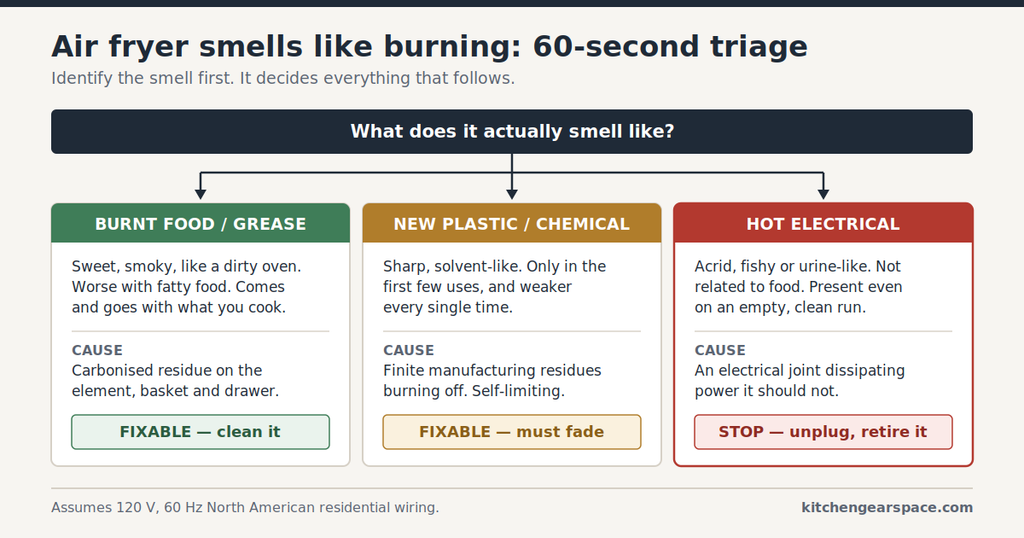
1. Does the smell track what you’re cooking? Stronger with bacon, chicken thighs, cheese or anything fatty. Faint or absent with a plain potato. Comes and goes. → You have a food and grease problem. Go to Branch A.
2. Is the appliance nearly new, and is the smell weaker every time you run it? Sharp, solvent-like, more “factory” than “food”. Present on the first cook, less on the second, less again on the third. → You have a break-in smell. Go to Branch B.
3. Does the smell appear on an empty, clean, cold-started run — and does it have nothing to do with food? Acrid. Some people describe it as fishy, or like a hot vacuum cleaner, or like a public toilet. It doesn’t fade. It may be strongest near the plug, the cord or the rear vents rather than inside the basket. → You have an electrical problem. Go to Branch C, and unplug the unit first.
If two of these seem to fit, treat the more serious one as the answer. An electrical smell hiding behind a grease smell is still an electrical smell.
Branch A — Burnt food and grease
This is the common case and the boring one. It is also completely fixable.
An air fryer is a small convection oven with a fan running at high speed a few inches from your food. Fat renders, aerosolises, and gets blown onto every interior surface — including the heating element sitting directly above the basket. Each subsequent cook re-heats that deposit. Fresh grease smokes at a certain point; grease that has already been cooked several times has become carbon and smells burnt at a much lower temperature than it did when it was new.
The tell: the smell scales with fat content and cooking temperature, and a genuinely clean unit run empty produces nothing.
What to do
Unplug the appliance and let it cool completely. Not warm — cool. Wash the basket, crisper plate and drawer in hot soapy water and dry them fully; trapped water under a crisper plate will steam and carry odour into the next cook.
The part almost everyone skips is the element and the ceiling of the cooking chamber, which is where the worst deposits sit. That surface is reachable on most models without removing a single screw — our guide to cleaning an air fryer without taking it apart covers how to get at it safely, and the baking soda method for the heating element handles deposits that a damp cloth won’t shift.
Do not remove the housing, unscrew panels, or work on anything behind the element. There is nothing you need back there, and everything back there is on the mains side.
Verifying the fix: after cleaning and drying, run the unit empty for five minutes at a moderate setting with the kitchen ventilated. Clean unit, no smell, problem solved. Clean unit, smell still there — you’re not in Branch A. Go to Branch C.
If the basket coating is peeling, flaking or worn through, cleaning won’t help; a damaged coating traps residue in the exposed substrate and keeps releasing it. Here’s how to tell when a basket is past saving.
Branch B — New-appliance chemical smell
New air fryers frequently smell for the first few uses. The materials involved are a mix of drawing and forming oils left on stamped metal parts, curing residues from coatings, and mould-release agents on plastic components. Manufacturers generally do not remove these; the first few heat cycles do.
The important property is that these residues are finite. There is a fixed quantity present, each heat cycle drives off a fraction of it, and the smell must therefore get weaker every single time. That gives you a test far more useful than “is there a smell”:
Is this run less smelly than the last one?
Getting weaker each time → break-in. It will end on its own. Flat or getting worse after three or four runs → not break-in. Go to Branch C.
What to do
Wash and thoroughly dry all removable parts before the first cook. Check inside the chamber and around the element for packaging fragments, foam or tape — a scrap of plastic pinned against a hot element produces an alarming smell and a genuinely unpleasant one.
Many manuals specify a break-in run: empty, at or near maximum temperature, for a set number of minutes, with the room ventilated. Some don’t, and a few explicitly warn against running empty. Check your own manual rather than following a number you read online, including ours — the correct figure varies by model and we won’t invent one for you.
By the third or fourth real cook this should be over. If it isn’t, it was never break-in.
One exception, and it matters: do not perform a break-in run if the smell resembles hot electrics rather than solvent. Running an appliance with a failing connection in the hope that the smell burns off is precisely the wrong response.
Branch C — The electrical smell
This is the one worth writing an article about, and it’s the one the recipe sites gloss over.
A hot-electrical smell is overheating polymer. Wire insulation, connector bodies, terminal blocks and switch housings are made from compounds that release characteristic breakdown products well before they visibly char. People describe the result as fishy, ammonia-like, or “hot” in a way that has nothing to do with cooking. Your nose is quite good at this. Trust it.
What is physically happening
An air fryer rated at 1,500 W on a 120 V supply draws roughly 12.5 A. That current passes through every connection in the appliance in series: the plug pins, the cord terminations, the crimp connectors feeding the heating element, the thermostat and thermal cut-out contacts, and the switching contacts on the control board. All of them carry the full 12.5 A.
A sound connection has a contact resistance of a few thousandths of an ohm. Power dissipated in a resistance is I²R, so at 12.5 A a 0.005 Ω joint produces about 0.8 W — nothing, spread over metal that conducts it away.
Now let that joint degrade. Vibration from the fan, thermal cycling between room temperature and a few hundred degrees, and slow oxidation of the contact surfaces all raise its resistance. At 0.1 Ω — still a small number — the same 12.5 A now produces about 15.6 W in a contact area smaller than a pea. That is soldering-iron territory, inside a sealed plastic housing.
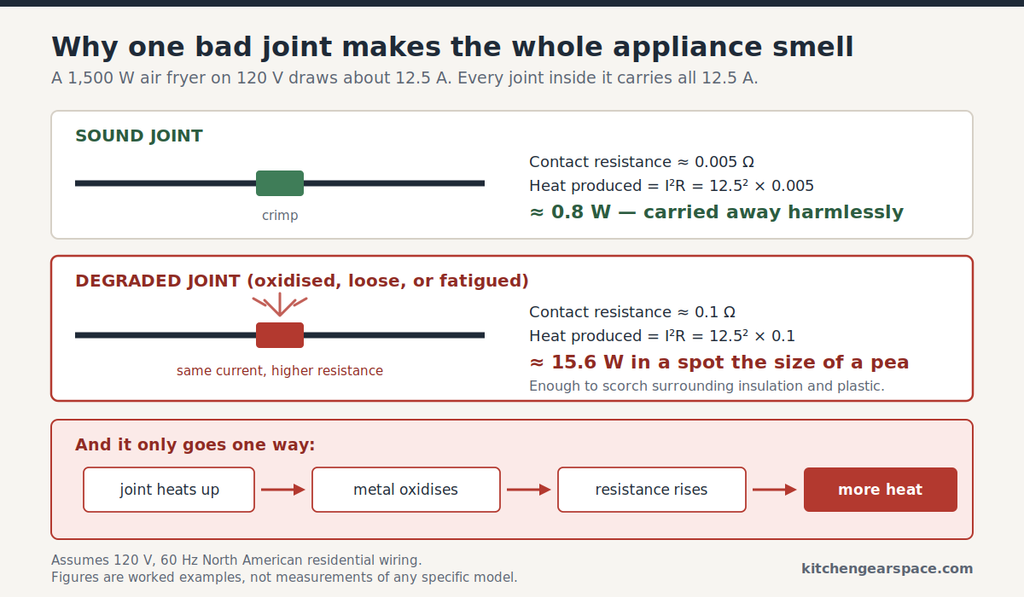
And it does not stabilise. Heat accelerates oxidation, oxidation raises resistance, higher resistance produces more heat. The loop only runs in one direction. This is why “it smells a bit but it still works fine” is not a reassuring observation — it’s an early one.
This is a documented failure mode, not a theory. In February 2023 the U.S. Consumer Product Safety Commission announced a recall of roughly two million Cosori air fryers because a wire connection inside them could overheat. The manufacturer’s own account identified closed-end crimp connectors as the component at fault. The CPSC notice records 205 reports of units catching fire, burning, melting, overheating or smoking. That is the exact mechanism described above, at scale, in a mainstream brand.
What to do
Stop using the appliance. Unplug it. Do not run it again “just to check” — you have already collected the diagnostic information, and each additional run advances the failure.
Then, in order:
- Check for a recall. Find the model number on the bottom rating plate and search the CPSC recall database, which has a dedicated air fryer category. If your model is listed you are usually entitled to a free replacement or refund regardless of receipt or age.
- Check the warranty. Many air fryers carry one to two years. An overheating internal connection is a manufacturing defect, not wear, and manufacturers generally handle it as a warranty replacement rather than a repair.
- Report it. If there’s no recall and no warranty, file a report at SaferProducts.gov. Recalls are triggered by accumulated reports. The Cosori recall existed because hundreds of people reported first.
- Retire the unit. Not to a garage, a dorm room or a relative. An appliance with a degrading mains connection is not safe for anyone.
Not for you to fix. We are not going to tell you to open it, inspect the crimps, or replace the cord. A mains-side connection repair inside a sealed appliance requires the right terminals, the right crimp tool, and the ability to verify the result — and getting it subtly wrong reproduces the original fault with your name on it. This also contradicts our own Terms: we do not publish internal repair instructions for mains-powered appliances.
It might not be the air fryer at all
Before you write off a working machine, rule out the wall.
That same 12.5 A flows through the receptacle, and a receptacle is just another set of connections. Worn contacts, a loose backstab termination behind the outlet, or a plug that no longer grips firmly will heat up under sustained load in exactly the same way — and the smell arrives in your kitchen with the air fryer running, so the air fryer takes the blame.
A test you can do safely. After a normal cook, switch off and unplug, then feel the plug body and the wall plate.
- Plug and wall plate near room temperature, smell was inside the chamber → the appliance side.
- Plug body noticeably warm or the wall plate warm → the plug/receptacle interface. Stop using that outlet and have an electrician look at it. Warm is not normal for a properly made connection at this current.
- Scorch marks, discoloration around the slots, or a plug that falls out under its own weight → stop using that outlet today.
Extension cords and power strips. Add a cord and you’ve added two more connections plus a length of conductor. A thin 16 AWG cord at 12.5 A over any real distance drops voltage and dissipates heat along its whole length. Plug the air fryer directly into the wall. If you can’t, that’s a wiring problem to solve properly, not to work around.
And check what else is on that circuit. At 12.5 A, a 1,500 W air fryer leaves only about 2.5 A of headroom on a 15 A branch circuit — roughly a couple of hundred watts. A kettle, toaster or microwave on the same circuit will take you over. That usually announces itself as a tripped breaker rather than a smell, but the two problems share a cause and often show up in the same kitchen. We cover the arithmetic in why your air fryer trips the breaker.
Smell versus smoke
They’re not the same signal and they don’t get the same response.
Light white haze during cooking is usually steam or vaporising fat, and it comes and goes with the food. Blue-grey or black smoke coming from the body of the appliance rather than from the food is not a cooking phenomenon. So is smoke that appears on an empty run. Either of those means stop, unplug, and treat it as Branch C. What air fryer smoke actually means goes through the distinction in more detail.
When it’s finished
If the unit is out of warranty, not recalled, and produces an electrical smell on a clean empty run, it’s finished. There is no maintenance step that reverses a degraded connection.
Two things worth knowing when you replace it. First, wattage is the number that determines what else can share the circuit — a 1,500 W model draws about 12.5 A and effectively owns a 15 A circuit on its own, while a 1,200 W model draws 10 A and leaves usable headroom. Second, that same figure drives your running cost, which over a few years is not trivial. We’ve worked through both in our guide to lower-wattage air fryers, which is where our affiliate links live.
What we’re not going to tell you to do
Some of the advice circulating on this topic is actively bad, so it’s worth being explicit.
We won’t tell you to mask it. Bowls of vinegar, lemon halves and baking soda in the basket address odour, not cause. On a Branch A problem they’re a substitute for cleaning. On a Branch C problem they’re a way of ignoring a fire risk.
We won’t tell you to open it. No panel removal, no element inspection, no cord replacement.
We won’t give you a break-in temperature and time. They vary by model and the only correct source is your manual.
We haven’t cooked in your air fryer. We don’t run a test kitchen and we don’t claim to. This article is built from appliance rating-plate figures, manufacturer service documentation, published recall records and electrical engineering analysis. Where a figure depends on your specific model, we say so instead of filling in a plausible number.
Frequently asked questions
Is food cooked in an air fryer that smells like burning safe to eat? If the smell was burnt food or grease, the food is generally fine — it may taste of the residue, but that’s a quality issue. If the smell was chemical, electrical or melting plastic, or if smoke came from the body of the appliance rather than the food, discard it and stop using the unit.
How long should a new air fryer smell like plastic? Usually the first two to four uses, and it should be noticeably weaker each time. The trend matters more than the duration. A smell that is still at full strength on the fourth run is not break-in.
Can I run my air fryer empty to clear the smell? Only for a suspected break-in or post-cleaning check, only if your manual permits it, and only with the room ventilated. Never run an empty cycle to “burn off” a smell that resembles hot electrics — you’d be running a failing connection at full load for no diagnostic gain.
Why does my air fryer smell like fish or ammonia when I’m not cooking fish? That description is commonly associated with overheating electrical insulation and connector materials rather than anything to do with food. Treat it as Branch C: unplug and stop using the unit.
Does a burning smell mean it’s about to catch fire? Not necessarily, and not usually today. But an electrical smell means a connection is dissipating power it shouldn’t, and that condition worsens with every hour of use rather than settling down. The CPSC recall record for this category shows where it ends if it’s ignored.
Can I just replace the power cord or the heating element? Not something we’ll walk you through. Both are mains-side components inside a sealed appliance, and a connection made without the correct terminals and crimp tooling reproduces the original fault. Check recall status and warranty first; if neither applies, replace the appliance.
About this article
This guide was written from an electrical engineering perspective, using manufacturer service documentation, appliance rating-plate figures, and analysis of recurring failure reports. Electrical figures assume 120 V, 60 Hz North American residential wiring on a 15 A or 20 A branch circuit.
Nothing here is a substitute for a licensed electrician or an authorised service technician. Do not open a mains-powered appliance to attempt a repair.
Last reviewed: August 2026

Kitchen Gear Space covers the engineering side of countertop cooking appliances — power draw, circuit loading, and why these machines fail. How we evaluate