Buy the air fryer with the lowest wattage number and you may well spend more on electricity, not less. That is the short version, and it is the opposite of what most “energy saving air fryer” lists tell you.
Here is why. Wattage on a rating plate is the peak draw of the heating element — the ceiling, not the average. An air fryer is a thermostatically controlled resistive heater. Once the chamber hits your setpoint, the element switches off, then back on, then off again, holding temperature by cycling. What you actually pay for is average power multiplied by time. A big element gets there fast and then loafs. A small element runs closer to flat out, for longer, to hold the same 400 °F.
So the question is not “which model has the smallest number on the box.” It is “which model finishes the cook soonest at the lowest average draw, in a size that matches what you actually cook.”
All electrical figures on this page assume 120 V, 60 Hz North American residential wiring on a 15 A or 20 A branch circuit.
Start here: three questions
1. How many people are you cooking for, most nights? One or two → a 2–4 qt basket. Three or more → 5–6 qt. If you are running two batches to feed everyone, you are paying two preheats and the compact unit has already lost.
2. Is this replacing your oven, or adding to it? Replacing it for weeknight portions is where nearly all the saving lives. Adding a fourth countertop appliance you use twice a month saves nothing.
3. What else is on that kitchen circuit? A 1,725 W fryer pulls about 14.4 A at 120 V. That is most of a 15 A branch circuit on its own. If your kettle or toaster shares the receptacle, size becomes a wiring question before it is an energy question.
If you answered “one or two people, replacing the oven, plenty of circuit headroom” — a mid-size 1,500–1,750 W basket model is your energy saver, and the rest of this page explains why the small one isn’t.
Rated watts are not energy used
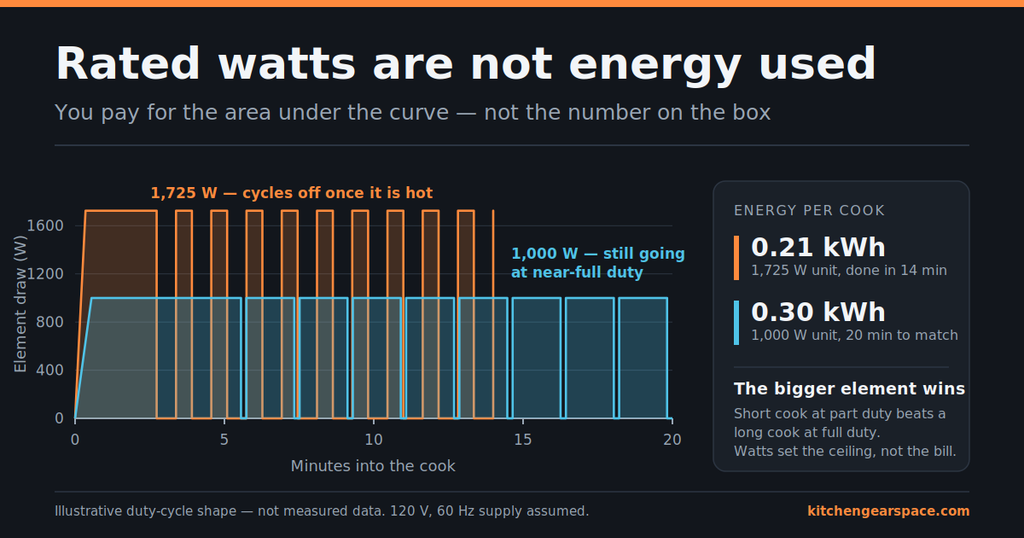
The chart above shows the shape of the thing. It is illustrative — it is drawn to show how thermostatic duty cycling works, not measured from a meter, and we say so on the image itself.
Two units, same food, same setpoint:
- The 1,725 W unit hits temperature in roughly two minutes, then cycles at partial duty for the rest of the cook and finishes early. Energy consumed: about 0.21 kWh.
- The 1,000 W unit takes longer to come up, runs at high duty throughout because it can barely stay ahead of the chamber’s heat losses, and needs longer to finish. Energy consumed: about 0.30 kWh.
Same job. Lower nameplate. More electricity.
This is not a quirk of air fryers — it is how every thermostatically controlled resistive appliance behaves. Once you see it, the whole “low wattage = energy saving” premise falls apart. Wattage sets how fast the appliance can deliver heat and how much current it draws from your wall. It does not, by itself, set your bill.
The arithmetic, so you can run it yourself
Three steps, no software needed.
Current draw: amps = watts ÷ volts. A 1,550 W fryer on a 120 V supply draws 1,550 ÷ 120 = 12.9 A.
Energy per cook: kWh = (watts ÷ 1,000) × hours. That same fryer, run at full duty for 20 minutes: (1,550 ÷ 1,000) × 0.333 = 0.52 kWh.
Cost: kWh × your rate. The EIA put the US residential average at 18.44 cents per kWh in May 2026. So 0.52 × $0.1844 = about 10 cents.
That 10 cents is a deliberate worst case — it assumes the element never cycles off. Real consumption after preheat is lower, typically well under it. Use the worst case as your upper bound and stop worrying about the rest.
Five models, run through the same math
Rated power figures below are as published by the manufacturer or listed by major retailers. Everything in the last four columns is calculated from those figures — we have not cooked in any of these units and we don’t have meter readings for them.
| Model | Rated power | Current @ 120 V | Capacity | Watts per quart | Worst-case kWh, 20 min | Cost @ 18.44¢ |
|---|---|---|---|---|---|---|
| Dash Compact Air Fryer | 1,000 W | 8.3 A | 2 qt | 500 W/qt | 0.33 kWh | $0.06 |
| Ninja AF101 | 1,550 W | 12.9 A | 4 qt | 388 W/qt | 0.52 kWh | $0.10 |
| Instant Vortex Plus 6QT | 1,700 W | 14.2 A | 6 qt | 283 W/qt | 0.57 kWh | $0.10 |
| COSORI TurboBlaze 6 Qt | 1,725 W | 14.4 A | 6 qt | 288 W/qt | 0.58 kWh | $0.11 |
| Chefman TurboFry 8 Qt | 1,700 W | 14.2 A | 8 qt | 212 W/qt | 0.57 kWh | $0.10 |
Look at the watts per quart column. It is the closest thing to an efficiency figure you can calculate from published specs, and it runs backwards from the marketing. The 1,000 W “energy saving” compact needs 500 W to service each quart of basket. The 8 qt unit needs 212 W. Small chambers are worse at holding heat relative to the food they contain, because surface area falls more slowly than volume as you shrink a box. The compact model has more wall per unit of food to lose heat through, and it has to keep paying for that loss the entire cook.
Now look at the cost column. The whole spread, across a 1,000 W compact and a 1,725 W six-quart, is five cents per cook. At one cook a day that is about $1.50 a month, before you account for the fact that the compact will take longer and may need two batches.
That is the honest headline here: which model you buy is very close to irrelevant to your electricity bill. How often you use it instead of the oven is what moves the number.
So which one should you actually buy?
Cooking for one or two, tight counter, snacks and single portions. A 1,000–1,300 W compact is fine. Not because it saves energy — it probably doesn’t — but because you will never fill a 6 qt basket and a half-empty chamber is wasted preheat. Size to your food. The Dash Compact 2 Qt is the straightforward version of this: 1,000 W, 8.3 A, no digital board to fail. Our small-space picks cover the footprint side of this.
Cooking for three or more, weeknight dinners. A 5–6 qt basket at 1,550–1,725 W. One batch, one preheat, done sooner. This is the class that genuinely displaces oven use, and displacing oven use is where the saving is.
Feeding four-plus or batch cooking. 7–8 qt. Watts per quart is at its best here — the Chefman TurboFry 8 Qt works out to 212 W per quart of basket, the lowest in the table. Check your circuit before you commit — at 14+ A this wants a receptacle it does not have to share.
If you have worked through that and concluded you need the mid-size 6 qt class, this is the one we would look at first on specification: the COSORI TurboBlaze 6 Qt, 1,725 W, DC motor, PFAS-free ceramic basket.
Affiliate link disclosure: We earn a commission if you buy through them, at no extra cost to you. They do not affect the figures above, which are calculated, not sponsored. We have not cooked in this model — our basis is published specification and the arithmetic above. See How We Evaluate.
The thing nobody tells you about extension cords
This one is pure electrical engineering and it is the single most common way people quietly make their air fryer less efficient.
A heating element is essentially a fixed resistance. For the COSORI at 1,725 W and 120 V, that resistance is about 8.35 ohms. Now put it on a long, thin extension cord, or a circuit already sagging under other load, and the voltage at the appliance drops. Power follows the square of voltage:
- 120 V → 14.4 A → 1,725 W
- 114 V (5% low) → 13.7 A → 1,557 W
- 108 V (10% low) → 12.9 A → 1,397 W
Ten percent less voltage costs you nearly twenty percent of your heating power. The fryer draws less current, so nothing trips — it just gets weak. It takes longer to preheat, longer to crisp, and the element runs at a higher duty cycle for a longer time to compensate. You lose on total energy and on results at the same time.
Plug it straight into a wall receptacle. If you must use a cord, use a short, heavy-gauge one rated well above 15 A. If your fryer seems slower than it used to be, voltage drop is worth ruling out before anything else — and if it is tripping the breaker rather than running weak, that is a different problem, covered in why your air fryer trips the breaker.
Circuit loading: 15 A or 20 A
Most US kitchen small-appliance receptacles are on 20 A circuits, but plenty of older kitchens have 15 A, and many kitchens put two receptacles on one circuit.
At 120 V:
- 1,000 W → 8.3 A
- 1,550 W → 12.9 A
- 1,700 W → 14.2 A
- 1,725 W → 14.4 A
A 1,725 W fryer alone on a 15 A circuit is inside its rating, but there is almost nothing left over. Add a 1,200 W kettle and you are past 24 A on a 15 A breaker — it will trip, and it should. Check what shares the circuit before you buy the big one. If you are unsure how your kitchen is wired, that is a question for a licensed electrician, not a guess.
What we can’t tell you
Three honest gaps, because pretending otherwise is how these articles go wrong:
There is no ENERGY STAR rating for air fryers. ENERGY STAR’s residential electric cooking products criteria cover conventional electric cooking tops and ranges — the cooking-top component of a range, and standalone or portable cooking tops. Countertop air fryers are not an eligible category. Any product page claiming an ENERGY STAR air fryer certification is claiming something that does not exist.
Those “saves 60% energy” claims are narrower than they look. They are not fabricated — but read the footnote. Philips, for example, published a widely repeated energy-saving figure for its Airfryer range and disclosed the basis for it on the product page: the energy cost of cooking one chicken breast or one salmon fillet, with no preheat, against an A-class oven, averaged from the company’s own internal lab measurements across a list of models. That is a real measurement of a genuinely favourable case. It is not a claim about your weeknight dinner, and “A-class oven” is a European energy label that does not describe a typical US range. Every headline percentage in this category has a footnote like that one. Read it before you believe it.
Nobody publishes real duty-cycle data. Manufacturers publish rated power. They do not publish average power over a cooking cycle, which is the figure that would actually let you compare models. Without that, all cross-model efficiency claims — ours included — are bounded estimates.
Standby draw varies and is rarely stated. Digital control boards and displays consume a small amount of power continuously. Manufacturers almost never publish it. If it matters to you, a plug-in energy meter costing under $20 will tell you exactly what your own unit does, both standby and in use. That is real data about your appliance, which beats anyone’s table.
Five things that cut consumption more than model choice
- Skip the preheat where the recipe allows. Preheat is the single most expensive part of a short cook — it is the only phase where the element runs at 100% duty. Many recipes tolerate a cold start with a couple of extra minutes at the end, which still runs at partial duty.
- Stop using the oven for small loads. This is the actual saving. An oven heats a large insulated cavity plus steel racks before any energy reaches your food; a basket heats about a tenth of the volume. If you are still baking six nuggets in a full-size oven, no air fryer purchase will fix that. Our air fryer vs oven comparison and the oven-to-air-fryer conversion guide cover the practical swap.
- Fill the basket properly — but don’t overfill it. Half-empty means you paid full preheat for half the food. Overfilled means blocked airflow, longer cooks, and worse results. Both cost energy.
- Keep it clean. Baked-on residue on the element and crisper plate impedes heat transfer and airflow, which lengthens cook times. You can do this without disassembling anything — see cleaning an air fryer without taking it apart.
- Give it clearance. Restricted exhaust means the unit re-ingests its own hot air and the thermostat behaves oddly. Clearance requirements are a five-minute check that affects every cook after it.
Do not open the appliance to inspect or repair anything inside it. There is nothing user-serviceable behind the housing of a mains-powered heating appliance, and nothing in this article requires you to.
FAQ
Does a lower-wattage air fryer use less electricity? Not necessarily. Wattage is peak draw, not consumption. A lower-wattage unit typically runs at a higher duty cycle for longer to reach and hold the same temperature, which can mean equal or greater total energy for the same food. Energy used is average power multiplied by time.
How much does it cost to run an air fryer per use? Take the rated watts, divide by 1,000, multiply by hours, multiply by your electricity rate. A 1,550 W unit for 20 minutes at the US residential average of 18.44¢/kWh works out to roughly 10 cents as an absolute worst case, and less in practice because the element cycles off.
Is there an ENERGY STAR certified air fryer? No. ENERGY STAR’s residential electric cooking products category covers conventional electric cooking tops and ranges. Countertop air fryers are not an eligible product type, so no air fryer carries a legitimate ENERGY STAR certification.
Will an air fryer trip a 15 amp breaker? On its own, no — a 1,725 W unit draws about 14.4 A at 120 V, which is within a 15 A circuit’s rating. It will trip if something substantial shares the circuit. Add a 1,200 W kettle and you are drawing more than the breaker will pass.
Does using an extension cord affect energy use? Yes, and not in the way most people expect. A long or thin cord drops voltage at the appliance. Heating power falls with the square of voltage, so a 10% voltage drop costs roughly 20% of heating power. The unit draws less current but takes longer to cook, which can raise total energy consumed. Plug into a wall receptacle directly.
Is an air fryer cheaper to run than an oven? For small and medium portions, generally yes — mainly because an oven heats a much larger insulated cavity and its racks before any energy reaches the food, and takes considerably longer to preheat. For a full oven load, the advantage narrows or disappears.
What size air fryer is most energy efficient? Whichever one matches your typical portion in a single batch. Watts-per-quart improves as capacity increases, but a large basket you routinely run half empty wastes preheat energy. Two batches in a compact unit costs more than one batch in a larger one.
About this article
This comparison is built from manufacturer specifications, published power figures and documented owner reports. We have not cooked in every model discussed — see How We Evaluate for what that does and doesn’t cover. Electrical figures assume 120 V North American residential wiring. Spotted something wrong? Email us and we’ll correct it.
Last reviewed: August 2026

Kitchen Gear Space covers the engineering side of countertop cooking appliances — power draw, circuit loading, and why these machines fail. How we evaluate